Est. 2018 · Pune, INToday's edition

The Ghenge Times

Vaishnav Ghenge, software engineer: backend & distributed systems

Profile · Noovosoft Technologies

Recurring billing engine cuts revenue failures by 30%

Vaishnav Ghenge has spent three years on production backends at Noovosoft Technologies: billing engines, real-time data pipelines and WebRTC video infrastructure. He is open to new roles.

3 yrs
building production systems
30%
fewer revenue failures after the billing rebuild
25%
more accurate weather data after the provider migration
45%
faster CI/CD builds after moving to uv

Ghenge architected the recurring billing engine behind Farmdesk's SaaS subscriptions, built on Mollie with retry logic for failed charges. Revenue failures fell by about 30%.

He led the migration of the product's weather data from DTN to OpenMeteo, which improved data accuracy by 25%, and resolved critical race conditions in integrations with government animal databases.

Moving the Python CI/CD pipelines to uv cut build times by 45%.

He cares about correctness, reliability and code that doesn't need a 40-minute explanation. Outside work he builds open-source tools (page A2) and writes about Django (page C1).

Roles at Noovosoft Technologies
Software DeveloperSep 2024 to Present
Software Developer InternAug 2023 to Sep 2024
  • Python
  • Django
  • Angular
  • TypeScript
  • Celery
  • Redis
  • PostgreSQL
  • Docker
  • WebRTC

Features

Page A2

Sessionly · formerly Vartalaap

A booking page with the video call built in

Sessionly puts scheduling and the call behind one link. You set weekly hours and sync Google Calendar; clients pick a time in their own timezone and get a private video room for that booking, joined from the browser. Media runs through Cloudflare acting as an SFU rather than peer to peer. No separate video app, no client account.

Booking flow: you set weekly hours synced with Google Calendar, a client books a time in their own timezone, and the booking opens a private video room joined from the browser.Your hours+ Google Calendar1Client booksin their timezone2Private roomvia Cloudflare SFU3
Fig. 1 One link covers the booking and the call.

Why build the call into the booking page?

Every extra app or sign-up is a chance for a client not to show. Booking a time should be the only step; the room comes with it.

  • WebRTC
  • Cloudflare
  • SFU
  • Google Calendar
Open beta ↗

Servio

Systemd gets a dashboard: start, stop, tail logs, deploy on push

A web GUI for Linux servers that talks to systemd over D-Bus: start and stop services, follow journald logs live, edit environment variables. A Git-integrated pipeline rebuilds and reloads a service on every push.

Fig. 2 Service state and logs come straight from systemd over D-Bus.

Why Go over Node.js or Python?

Direct D-Bus bindings for systemd, and goroutines to stream logs from many services at once, shipped as a single binary with no runtime to install.

  • Go
  • systemd
  • D-Bus
  • WebSockets
  • React
  • SQLite
Source on GitHub ↗

django-silky

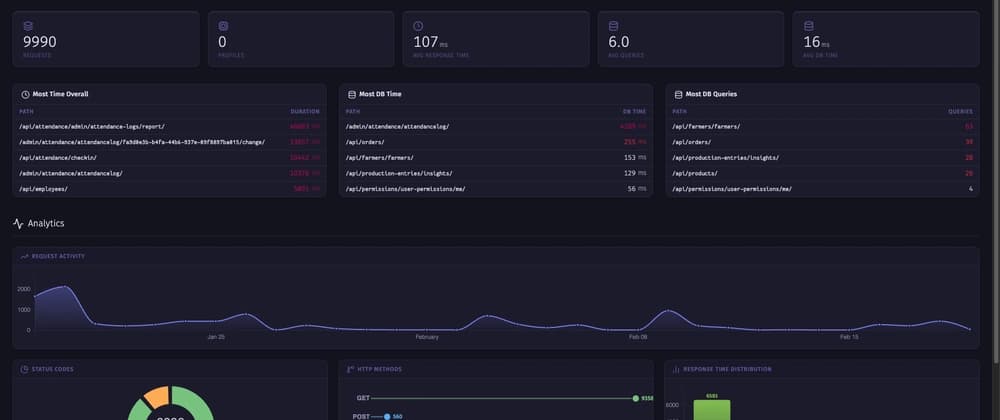
Profiler fork ships dark mode, D3 charts and N+1 detection

A modernized fork of the django-silk profiler: persistent dark and light themes, an inline filter bar, D3 analytics dashboards, N+1 query detection with endpoint attribution, and self-hosted icons with no CDN calls. A drop-in replacement with no new migrations.

Fig. 3 The slow endpoint, and the N+1 pattern inside it, flagged per request.

Why fork instead of contributing upstream?

Theming, D3 analytics and self-hosted assets meant architectural rewrites, not patches. Upstream review would have taken weeks; the fork shipped in a day.

  • Python
  • Django
  • D3.js
  • CSS custom properties
  • PostgreSQL
On PyPI ↗

Markets

Page B1

Core: daily, in production. Held: shipped with it, comfortable. Watchlist: used on projects, still building depth.

Tech holdings, part 1: core and held
HoldingPositionYrs
PythonLanguageCore5+
DjangoBackendCore3+
PostgreSQLInfraCore3+
TypeScriptFrontendCore3+
ReactFrontendCore3+
WebRTCSystemsCore2
DockerInfraHeld3+
CeleryBackendHeld·
RedisInfraHeld2+
AngularFrontendHeld2+
Next.jsFrontendHeld2+
GoLanguageHeld1+
Tech holdings, part 2: held and watchlist
HoldingPositionYrs
FastAPIBackendHeld·
AWSInfraHeld·
WebSocketsSystemsWatchlist·
SystemdSystemsWatchlist·
NginxInfraWatchlist·
KubernetesInfraWatchlist·
gRPCBackendWatchlist·
GraphQLBackendWatchlist·
D3.jsFrontendWatchlist·
React NativeFrontendWatchlist·
SupabaseInfraWatchlist·
JavaLanguageWatchlist·

Opinion

Page C1
All articles on dev.to ↗

Comics

Page D1

The Night Shift

by v.g.
  1. Panel 1. 11:02 p.m. The developer frowns at a failing test on the laptop, coffee still steaming. "One failing test. Ten minutes, tops."11:02 P.M.ONE FAILING TEST.TEN MINUTES, TOPS.
  2. Panel 2. 1:15 a.m. The developer turns to the rubber duck and explains, hand raised: "So, duck: the retry fires, then the webhook..."1:15 A.M.SO, DUCK: THE RETRY FIRES,THEN THE WEBHOOK...
  3. Panel 3. 3:46 a.m. The developer stops mid-sentence, eyes wide: "...fires twice. Oh no." The duck has not moved.3:46 A.M....FIRES TWICE.OH NO.
  4. Panel 4. 3:47 a.m. The tests pass. The developer rests their chin in one hand and smiles at the duck. Caption: the duck heard it first.3:47 A.M.THE DUCK HEARD IT FIRST.

Classifieds

Page D2

Situation wanted

Building something that needs to hold up under load?

Backend engineer, three years in production. Python, Django and Go. Billing, real-time data, WebRTC. Open to new roles.

Reply to vaishnavghenge@gmail.com

Free to a good home

One Django profiler, dark mode included. No new migrations.

pip install django-silky